When shopping for your first wood pellet cooker, you will hit a major crossroads within five minutes of browsing:
Do you buy a traditional horizontal barrel grill (like a Traeger Pro 575 or Pit Boss PB440), or do you get a tall vertical cabinet smoker (like the Pit Boss Pro Series 4 or Camp Chef XXL)?
Both burn 100% hardwood pellets, both use an electric auger and a digital PID controller, and both plug into a standard 110V wall outlet.
Yet they cook completely differently.
If you pick the wrong one, you will either end up cursing a horizontal grill because you can’t fit enough food for your family reunion, or you will regret buying a vertical cabinet the first time you want to grill a quick batch of weeknight burgers and realize it can’t sear meat to save its life.
Here is the straightforward breakdown from someone who runs both styles on the back deck year-round.
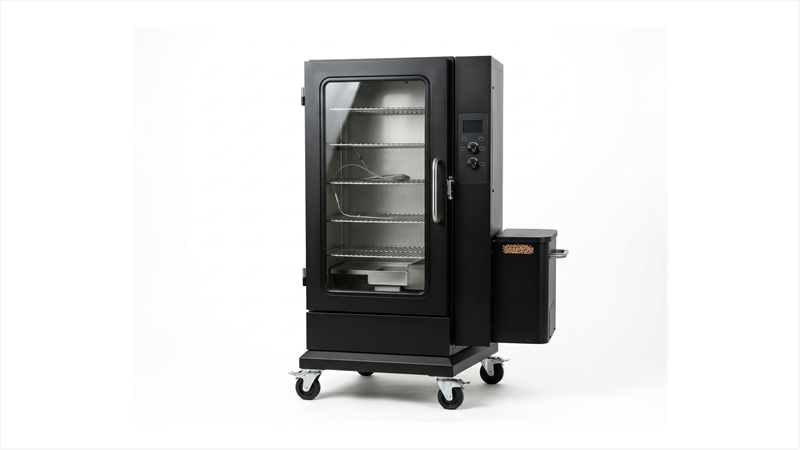 Figure 1: Vertical cabinet smokers maximize vertical rack space for batch smoking, while horizontal barrel grills provide the versatile airflow needed for high-heat roasting and searing.
The Core Difference: Specialized Smoker vs. Backyard All-Rounder
The simplest way to understand the difference comes down to one question: Do you want an outdoor convection oven that can sear, or a dedicated meat-smoking cabinet?
Horizontal Pellet Grills (The All-Rounders)
Horizontal grills look like traditional offset smokers or charcoal barrels. The firepot sits on the floor of the barrel, shielded by a metal drip tray that slopes down into an external grease bucket.
- Airflow Pattern: Heat and smoke rise from the center, travel horizontally across the cooking grates, and exit through a side chimney stack.
- Cooking Style: Direct and indirect grilling, baking, roasting, and low-and-slow smoking.
- Top Temperature: Usually 450°F to 500°F (some, like Pit Boss, feature open flame sliders hitting 1,000°F).
Vertical Pellet Smokers (The High-Capacity Specialists)
Vertical smokers look like tall outdoor mini-fridges. The pellet hopper and auger usually sit low in the rear or side, feeding a firepot at the very bottom. Directly above the firepot sits a heavy water pan, followed by four to six chrome cooking racks stacked on top of each other.
- Airflow Pattern: Natural draft convection. Heat and smoke rise straight up from the bottom through all the racks and exit out top-mounted dampers.
- Cooking Style: 100% low-and-slow smoking (150°F to 350°F).
- Top Temperature: Capped at 350°F to 400°F. They cannot sear, char, or grill burgers directly.
Head-to-Head Comparison: Real-World Testing
| Feature | Horizontal Pellet Grill (e.g., Traeger Pro 575) | Vertical Pellet Smoker (e.g., Pit Boss 4-Series) |
|---|---|---|
| Cooking Space Footprint | 500 – 800 sq. in. (Spread wide on 1–2 flat tiers) | 1,000 – 2,000+ sq. in. (Stacked high on 4–6 racks) |
| Searing & Grilling Capability | Yes (Hits 450°F–500°F; great for chicken skin and burgers) | No (Capped around 350°F; cannot crisp skin quickly) |
| Deck Footprint | Wide footprint (requires 4 to 5 feet of horizontal deck width) | Compact footprint (takes up roughly a 2x2 ft floor space) |
| Pellet Consumption (at 225°F) | ~1.2 to 1.8 lbs per hour | ~0.8 to 1.2 lbs per hour (Better thermal retention) |
| Water Pan Integration | Rare (requires foil pan on grate) | Built-in standard water pan above firepot |
| Cleaning Effort | Easy (foil on drip tray, shop-vac firepot) | Moderate (grease drips across multiple rack levels) |
| Best Amazon Option | Traeger Pro 575 | Pit Boss Austin XL |
3 Reasons to Pick a Horizontal Pellet Grill
1. You Only Have Room for One Backyard Cooker
If you don’t already own a gas grill or charcoal kettle, buying a vertical smoker is a mistake. A vertical smoker cannot grill steaks, cannot crisp hot dogs, and cannot char burger patties.
A horizontal grill can handle your 14-hour Sunday pork shoulder, and then turn around on Tuesday night at 450°F to grill salmon fillets or chicken wings with crispy skin.
2. Cleaner Drip Management
In a horizontal cooker, fat from your brisket drips onto a single angled metal shield and flows straight into an external grease bucket.
In a vertical smoker with four racks, raw chicken fat on the top shelf will drip onto the pork belly on the middle shelf, which drips onto the brisket on the bottom shelf. You have to plan your meat placement carefully so poultry never sits above ready-to-eat meats.
3. Easier Access to Food
To spritz or wrap a pork butt on a horizontal grill, you just lift the lid and the entire cooking grate is accessible. On a vertical smoker, pulling out a heavy, hot middle rack packed with two 10-lb pork butts without tipping over the rack requires heat-resistant gloves and steady hands.
3 Reasons to Pick a Vertical Pellet Smoker
1. Unmatched Capacity Per Dollar
If you regularly host tailgate parties, church cookouts, or smoke large batches of beef jerky, summer sausage, and bacon, horizontal grills get cramped fast.
A vertical smoker costing around $450 easily gives you over 1,400 square inches of cooking area. You can fit six full racks of ribs, three whole turkeys, or dozens of sausage links hanging from hooks simultaneously.
2. Superior Fuel Efficiency in Cold Weather
Because heat naturally rises in a column and vertical smokers typically feature double-walled insulated cabinet doors with rubber gaskets, they retain heat significantly better than a thin steel barrel.
On a 32°F winter day, our horizontal barrel burns roughly 2 lbs of pellets per hour to hold 225°F. An insulated vertical cabinet sips roughly 1 lb per hour under the exact same conditions.
3. Built-In Water Pan Humidity
Vertical cabinets place a large water tray directly between the firepot and the lowest cooking rack. This creates an ultra-humid microclimate inside the cabinet. Moisture condenses on the cold meat surface, allowing smoke particles to adhere more aggressively and producing a noticeably darker mahogany bark on long cooks.
Which One Should You Buy?
- Buy a Horizontal Pellet Grill if: This is your primary backyard grill. You want the versatility to smoke low-and-slow on weekends, but you still want to cook weeknight burgers, steaks, and roasted vegetables without owning two separate grills. Start with the Traeger Pro 575 or Z Grills 450A.
- Buy a Vertical Pellet Smoker if: You already own a gas grill or griddle for searing, and your main goal is smoking high volumes of ribs, jerky, pork butts, or holiday turkeys with minimal fuel consumption.